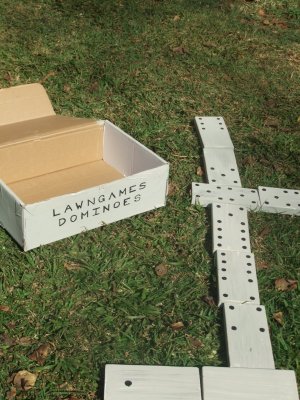
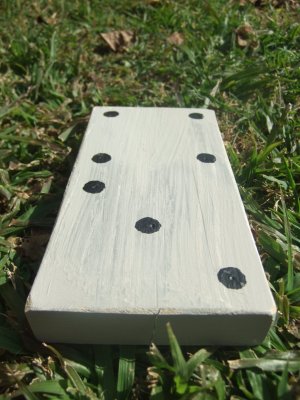
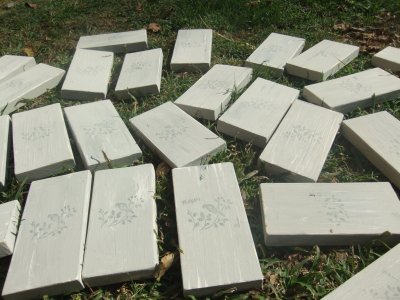
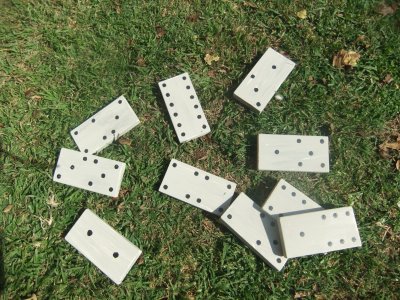
Fun factor Dominoes is an old classic game. Played one-on-one, it is a game of skill and chance that can be enjoyed by young and old alike. This medium to slow paced game can be played on the lawn or on a large table. Our dominoes tiles are hand crafted, with vintage French design. Enjoy a leisurely game outside, on a pleasant day, perhaps under the shade, with a cold drink in hand. Mix it up, ask a stranger to play, and get to know them. Perfect activity to help your guests and new family members to mingle with an old familiar game. Or challenge your boss at your work function...History
The earliest mention of dominoes is from Song Dynasty China,
found in the text Former Events in Wulin. Dominoes first
appeared in Italy during the 18th century, and although it
is unknown how Chinese dominoes developed into the modern game,
it is speculated that Italian missionaries in China may have
brought the game to Europe. The name "domino" is from the
resemblance to a kind of hood worn during the Venice carnival.
Game Setup and Rules
Game 1: Blocking Game
The most basic domino variant is for two players.
The 28 tiles are shuffled
face down and form the stock or boneyard. Each player
draws seven tiles; the remainder are not used. Once the
players begin drawing tiles, they are typically placed
on-edge before the players, so that each player can see
his own tiles, but none can see the value of other players'
tiles. Every player can thus see how many tiles remain in the other
players' hands at all times during gameplay. One player begins by
downing (playing the first tile) one of their tiles. This tile starts
the line of play, a series of tiles in which adjacent
tiles touch with matching, i.e. equal, values. The players
alternately extend the line of play with one tile at one
of its two ends.
The game ends when one player wins by playing their last tile,
or when the game is blocked because neither player can play.
If that occurs, whoever caused the block gets all of the
remaining player points not counting their own. Here, scoring
happens at the end of the game. After a player has emptied his hand,
thereby winning the game for their team, the score consists of the total
pip count of the losing teams' hands. If a game is blocked because no
player can move, the winner is often determined by adding the pips in
players' hands
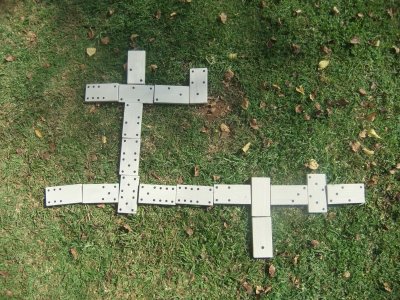
Game 2: Draw Game The Draw game, is similar to the blocking game. Here, however, the doubles serve as spinners, i.e., they can be played on all four sides, causing the line of play to branch. In practice, players often play tiles at right angles when the line of play gets too close to the edge of the table. 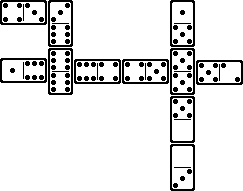
Players are additionally allowed to draw as many tiles as desired from the stock before playing a tile, and they are not allowed to pass before the stock is (nearly) empty. The score of a game is the number of pips in the losing player's hand plus the number of pips in the stock. Most rules prescribe that two tiles need to remain in the stock. The Draw game is often referred to as simply "dominoes". Included in the Kit:
|