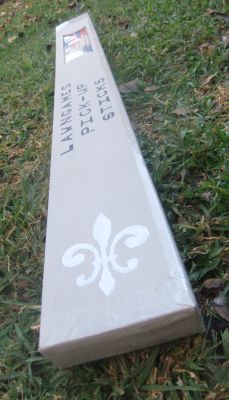
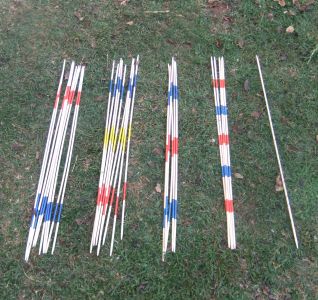
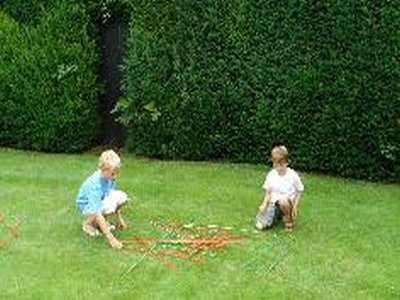
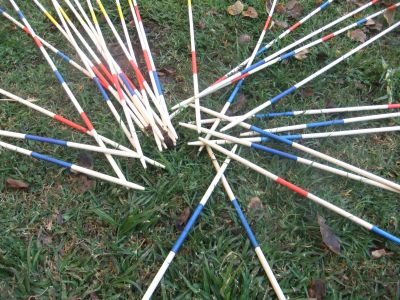
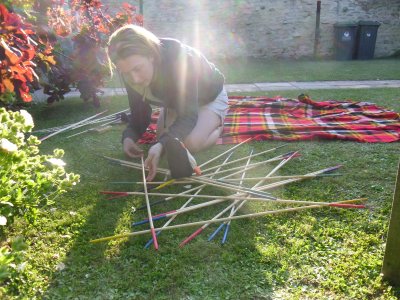
Fun factor This old childhood classic is reimagined as a giant lawn game that can be enjoyed by young and old alike. It is a fun game of tention, where only the steadiest of hands succeed... The anticipation of accidentally moving unwanted sticks adds to the fun! "It moved,it moved!" ... "No, it didn't!"History
Mikado is a pick-up sticks game originating in Europe. In 1936 it was brought from
Hungary to the USA and was mostly called pick-up sticks. This term is not very
specific in respect to existing stick game variations. Probably the "Mikado" name
was not used because it was a brand name of a game producer. The game got its name
from the highest scoring (blue) stick "Mikado" (Emperor of Japan). The buddhistic
Chien Tung also contains a stick called "emperor". The house of "Tsuchimikado" adapted
in the 16th century some culture, possibly also the "Chien Tung" oracle. Maybe in the
course of Japonism in the 19th / 20th century the "Zitterwackel" game had changed
to "Mikado" (probably first named "Tsuchimikado").
Game Setup and Rules
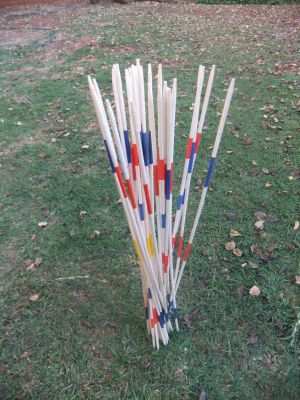
First, the sticks are bundled together in an upward position. They are then let
loose to fall to the ground. Players might have to step back here, to allow the
sticks to fall randomly to the ground. If the sticks do not fall right, you can try
again. This is the start position.
The first player starts by picking up a stick. He/she may only move that specific stick, and the other sticks may NOT move. If another stick is touched or moved, the player may not continue, and it will be the next players turn. If the stick was removed successfully, it is lay down next to the player on the ground, and he/she continue by picking up the next stick. Once a player has won his/her first stick, the stick is allowed to be used to pick up the other sticks. The sticks have different colours, and different points associated with them. When all the sticks are picked up, they points are tallied, and the person with the highest score wins! Included in the Kit:
|